ByJohn A
Navigating the Tough Prereqs of Computational Linguistics Degrees
The rapid rise of advanced artificial intelligence models, conversational chatbots, and automated text analysis tools has made computational linguistics one of the most attractive and lucrative specializations in modern higher education. However, students entering this field quickly discover a sobering reality: bridging the gap between human language and computer code requires mastering an exceptionally brutal set of academic prerequisites.
Computational linguistics is not just a standard software programming major, nor is it a pure humanities degree. It is a rigorous, interdisciplinary hybrid path that forces students to split their cognitive energy between two completely different academic worlds.
The Dual Burden of Language and Logic
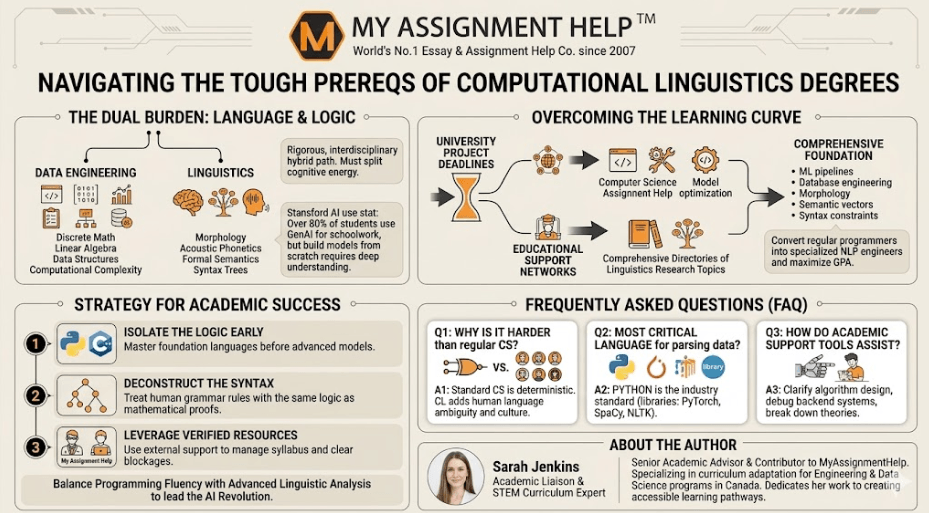
Undergraduate and graduate scholars pursuing specialized NLP tracks face a demanding syllabus footprint. On the data engineering side, they are expected to demonstrate immediate proficiency in discrete mathematics, linear algebra, data structures, computational complexity, and complex statistical probabilities. On the linguistics side, they must simultaneously master abstract structural frameworks, including morphology, acoustic phonetics, formal semantics, and syntax trees.
According to the Stanford University 2026 AI Index Report, over 80% of college and university students now actively use generative AI tools to assist with their general schoolwork. Yet, paradoxically, when it comes to building or understanding these very models in a computational linguistics setting, shortcuts do not work. When forced to write customized tokenizers, clean massive datasets, or optimize transformer algorithms from scratch, students frequently find themselves overwhelmed by the sheer volume of technical prerequisites.
Overcoming the Learning Curve
The intensive nature of university project deadlines often leaves students struggling to balance theoretical clarity with flawless code execution. When a student is stuck debugging a machine learning model in PyTorch while trying to complete an analytical report on syntactic variations, standard textbooks rarely provide the immediate, practical breakthroughs required to clear the bottleneck.
Recognizing these systemic learning challenges, modern educational support networks have evolved to provide custom-tailored academic resources. Utilizing specialized, expert-guided computer science assignment help enables emerging developers to build a comprehensive foundation in machine learning pipelines, mathematical modeling, and backend database engineering. This technical grounding ensures that students can confidently construct the underlying systems necessary to host advanced language-processing frameworks without destroying their GPA.
Once the engineering foundations are secured, students can dedicate the necessary analytical hours to mastering semantic frameworks. Reviewing comprehensive directories of linguistics research topics allows developers to study morphology, semantic vectors, and syntactic constraints. This structural insight provides the missing link in AI architecture design, converting regular software programmers into specialized NLP engineers capable of minimizing algorithmic bias and optimizing contextual awareness.
Strategy for Academic Success
To survive a computational linguistics curriculum, students must adopt an organized, multi-layered approach to learning:
- Isolate the Logic Early: Master foundational languages like Python and C++ before trying to implement advanced deep learning models.
- Deconstruct the Syntax: Treat human language grammar rules with the same structural logic you would apply to compiler design or mathematical proofs.
- Leverage Verified Resources: Do not hesitate to use external academic support networks to manage complex syllabus loads, clear coding blockages, and maintain structural consistency across intensive project deadlines.
By balancing practical programming fluency with advanced linguistic analysis, determined scholars can successfully navigate these rigorous prerequisite hurdles—positioning themselves at the absolute forefront of the ongoing AI revolution.
See also: How Technology Is Changing Media Consumption
Frequently Asked Questions (FAQ)
Q1: Why is a computational linguistics degree harder than a standard computer science track?
A: Standard computer science focuses heavily on deterministic systems and logic. Computational linguistics adds human language variations, semantic ambiguities, and cultural contexts into the mix, forcing students to master both mathematical programming and complex language theory.
Q2: What programming language is most critical for parsing human language data?
A: Python is the absolute industry standard due to its unmatched ecosystem of NLP and machine learning libraries, such as PyTorch, Hugging Face Transformers, SpaCy, and NLTK.
Q3: How do academic support tools assist with complex programming coursework?
A: They provide direct, expert-guided assistance to clarify algorithm design, debug backend systems, and break down complex computational theories, helping students maintain their grades during intensive semesters.
About the Author: Sarah Jenkins, Academic Liaison & STEM Curriculum Expert
Sarah Jenkins is a senior academic advisor and regular contributor to the educational resource initiatives at MyAssignmentHelp. Specializing in student retention strategies and curriculum adaptation within Canada engineering and data science programs, she dedicates her work to building accessible learning pathways for modern undergraduate scholars. Her writing provides practical, actionable strategies for students navigating the heavy prerequisite demands of hybrid tech degrees like computational linguistics.